










Sterling Heights has a growing network of trails, sidewalks, park pathways, and major road corridors used by bicyclists for recreation and transportation.
Understanding bicycle safety in the city requires looking at more than crashes alone. It also means examining where people ride, how Sterling Heights is expanding its nonmotorized infrastructure, what Michigan crash data shows about bicyclists statewide, and which local sources can be used to monitor future trends.
This Sterling Heights Bicycle Safety Report brings those pieces together using official public data and local government resources.
If you were injured while riding, our Sterling Heights Bicycle Accident Lawyer page explains the legal and insurance issues that can arise after a collision.
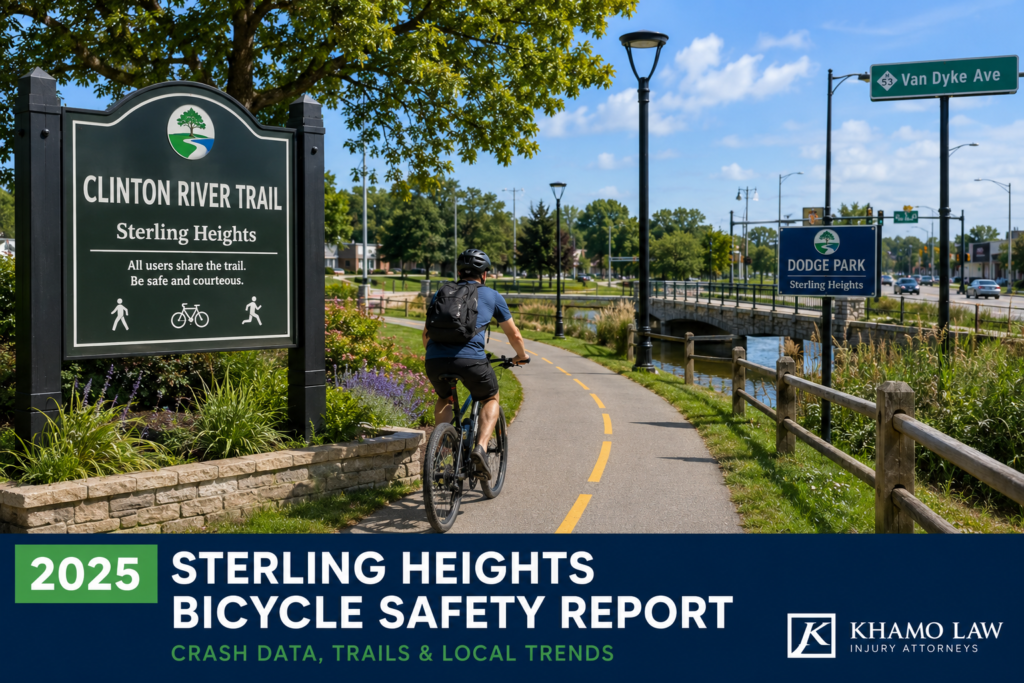
The 2025 Sterling Heights Bicycle Safety Report reviews bicycle crash data, local trails, and riding infrastructure using official Michigan and Sterling Heights sources.
2025 Michigan Bicycle Crash Data
Michigan Traffic Crash Facts reports that in 2025:
- 1,763 bicyclists were involved in traffic crashes
- 35 bicyclists were killed
Those figures are statewide and should not be interpreted as Sterling Heights-specific statistics.
Michigan Traffic Crash Facts now provides 2025 data through its Data Query Tool and has introduced a City View visualization designed to help users examine crash information for individual Michigan communities.
That makes it possible to track Sterling Heights bicycle trends more precisely as city-level data is queried and validated.
Why We Do Not Publish Unverified Sterling Heights Crash Counts
Local crash statistics can be useful, but only when the geographic filters, crash definitions, and reporting years are clear.
For example, a number can differ depending on whether it represents:
- Bicycle-involved crashes
- Individual bicyclists involved
- Injury crashes
- Fatal crashes
- Crashes occurring within Sterling Heights city limits
- Macomb County crashes involving Sterling Heights residents
- A single year
- A five-year period
For that reason, Khamo Law does not publish a Sterling Heights bicycle-crash number unless it can be tied directly to an official query or government dataset.
Readers who want to examine current official data can use the Michigan Traffic Crash Facts Data Query Tool and the SEMCOG Traffic Crash Data Tool.
What Michigan’s Statewide Numbers Tell Us
The statewide numbers provide context for local bicycle safety.
In 2025, Michigan recorded 35 bicyclist fatalities among 1,763 bicyclists involved in reported traffic crashes.
These figures do not tell us where every collision occurred or why each crash happened.
They do show why bicycle safety remains an important transportation issue throughout Michigan.
Crash severity can depend on factors such as:
- Vehicle speed
- Roadway type
- Intersection design
- Driver behavior
- Visibility
- Lighting
- Bicycle position
- Turning movements
- Passing distance
A local Sterling Heights analysis should therefore look at both crash counts and the roadway environment where those crashes occur.
Sterling Heights Has an Extensive Trail Network
Sterling Heights reports more than 15 miles of dedicated trails throughout its park system.
The city’s trail network includes asphalt, concrete, and gravel pathways used by:
- Bicyclists
- Walkers
- Joggers
- Families
- Other permitted nonmotorized users
The City of Sterling Heights Trail Use and Maps resource provides maps and current trail-use information.
This trail network is an important part of bicycle safety because cycling in Sterling Heights does not occur only on major arterial roads.
Riders may transition between:
- Park trails
- Neighborhood streets
- Sidewalks
- Crosswalks
- Shared-use paths
- Commercial corridors
- Major intersections
Those transition points can create different interactions with motor vehicles.
The Clinton River Trail System
One of Sterling Heights’ most important nonmotorized resources is the Clinton River Trail System.
The system connects multiple parks and recreational areas and provides bicyclists with an alternative to riding exclusively on major commercial roadways.
Shared-use trails can reduce some interactions with motor vehicles, but cyclists may still encounter vehicles when trails:
- Cross streets
- Approach parking areas
- Intersect driveways
- Connect with sidewalks
- Reach park entrances
- Transition back to public roads
These transition locations are often worth examining when evaluating local bicycle infrastructure.
Sterling Heights Trail Rules for Bicyclists
The City publishes trail rules intended to support safe interaction between bicyclists, pedestrians, and other trail users.
The city’s guidance asks cyclists to:
- Keep to the right
- Pass slowly on the left
- Give an audible warning before passing
- Yield to pedestrians
- Observe applicable trail speed rules
The rules reflect the fact that Sterling Heights trails are generally shared-use environments, not bicycle-only facilities.
Cyclists should therefore expect to encounter people walking, jogging, pushing strollers, or otherwise using the same paths.
Sterling Heights Is Expanding Walking and Biking Infrastructure
Sterling Heights voters approved the Pathway to Play and Preservation initiative in November 2024.
The program includes investments in:
- Sidewalk completion
- Sidewalk maintenance
- New bike and hike trails
- Improved access to natural areas
- Park connections
- Nonmotorized recreation
The City specifically plans a natural hike-and-bike trail providing access to the Sterling Heights Nature Preserve.
The initiative also includes a bike/hike trail at the future Red Run Park.
These investments suggest that nonmotorized transportation and recreation will continue to become a larger part of the city’s infrastructure.
The Iron Belle Trail Connection
Sterling Heights also identifies the Iron Belle Trail as part of its long-term pathway planning.
The Iron Belle Trail is a statewide Michigan trail network designed to connect communities through hiking and bicycling routes.
For Sterling Heights, regional trail connections can increase opportunities for residents to travel between local parks, neighboring communities, and broader nonmotorized routes.
As trail connectivity increases, local bicycle-safety planning becomes increasingly important at intersections between trails and vehicle traffic.
Major Roads Bicyclists May Encounter in Sterling Heights
Sterling Heights contains several major roads that cyclists may cross, approach, or occasionally travel along depending on the location and lawful route.
Examples include:
- Van Dyke Avenue / M-53
- Hall Road / M-59
- Mound Road
- Dequindre Road
- Schoenherr Road
- Ryan Road
- Dodge Park Road
- Metropolitan Parkway / 16 Mile Road
- Clinton River Road
These roads vary substantially in traffic volume, lane configuration, speed, commercial access, and surrounding development.
A cyclist traveling through a neighborhood or trail network may still need to interact with one or more of these corridors.
Why Vehicle Speed Matters
Bicycle crash severity is influenced by many factors, but vehicle speed is particularly important.
Michigan Traffic Crash Facts research has found that fatality rates in bicycle-involved crashes generally increase as posted speed limits increase.
This does not mean that every high-speed road is unsafe or that speed caused every serious bicycle crash.
It does reinforce the importance of evaluating:
- Vehicle speed
- Road design
- Crossing locations
- Visibility
- Traffic controls
- Separation between motorists and cyclists
when studying bicycle safety.
Intersections and Bicycle Safety
Many bicycle crashes occur where the paths of motorists and cyclists cross.
Potential conflict points include:
- Signalized intersections
- Stop-controlled intersections
- Driveways
- Parking lot entrances
- Trail crossings
- Crosswalks
- Right-turn lanes
- Left-turn movements
Drivers may be focused on other vehicles and fail to notice a cyclist approaching from the side.
Cyclists may also have difficulty predicting whether a turning driver has seen them.
These situations make visibility, signal compliance, and careful turning behavior important for everyone using the road.
Michigan’s Three-Foot Passing Rule
Michigan law generally requires drivers overtaking a bicyclist traveling in the same direction to pass with at least three feet of clearance.
When maintaining three feet is impracticable, the driver must still pass at a safe distance and safe speed.
Passing-distance laws are particularly relevant on roads without dedicated bicycle lanes.
Drivers should not attempt to squeeze past a cyclist when there is insufficient room to do so safely.
For more information about Michigan bicycle law and accident claims, see our Michigan Bicycle Accident Lawyer page.
Bicycle Crashes Involving Turning Vehicles
Turning vehicles can create one of the most common conflict situations for bicyclists.
A driver may:
- Turn left across a cyclist’s path
- Turn right across a bicycle’s travel line
- Exit a parking lot
- Enter a commercial driveway
- Cross a trail or sidewalk
Drivers may underestimate a cyclist’s speed or fail to notice the bicycle entirely.
Video, witnesses, traffic controls, and scene photographs can become important when determining what happened.
Driveways and Commercial Corridors
Sterling Heights contains extensive commercial development along roads such as Van Dyke, Hall Road, and Mound Road.
Commercial corridors often contain:
- Frequent driveways
- Parking-lot entrances
- Right-turn movements
- Vehicles crossing sidewalks
- Multiple lanes of traffic
These environments can create repeated interaction points between motorists, bicyclists, and pedestrians.
A bicycle-safety analysis should therefore look beyond traditional intersections.
Bicycle Crashes and Commercial Vehicles
Commercial trucks and delivery vehicles create additional concerns for cyclists because larger vehicles can have substantial blind areas and need more space to turn.
Potential issues include:
- Right-turn conflicts
- Wide turns
- Mirror visibility
- Lane position
- Commercial driveways
- Vehicle size
For crashes involving commercial vehicles, see our Sterling Heights Truck Accident Lawyer page.
Where Sterling Heights Bicycle Crash Data Comes From
Reliable bicycle-crash research should rely on primary or authoritative data.
The principal sources we recommend are:
Michigan Traffic Crash Facts
Michigan Traffic Crash Facts is based on Michigan police-reported crash data and allows users to build custom queries.
Available data includes:
- Crash year
- Location
- Crash severity
- Bicycle involvement
- Pedestrian involvement
- Roadway characteristics
- Time
- Weather
- Other crash factors
SEMCOG
The SEMCOG Traffic Crash Data Tool provides crash information for Southeast Michigan.
SEMCOG allows users to filter crashes based on factors including:
- Jurisdiction
- Year
- Crash severity
- Bicycle involvement
- Pedestrian involvement
- Commercial vehicles
- Road names
- Time
- Crash type
SEMCOG identifies bicycle-involved crashes using its bicycle crash factor.
City of Sterling Heights
The City provides additional information concerning:
- Trails
- Sidewalk projects
- Pathway development
- Road projects
- Parks
- Nonmotorized transportation
These sources help explain the infrastructure surrounding local crash data.
What We Will Track in Future Updates
As new official data becomes available, this report can be updated to track:
- Sterling Heights bicycle-involved crashes by year
- Bicycle injuries
- Fatal bicycle crashes
- Five-year trends
- Crash severity
- Time of day
- Day of week
- Intersection involvement
- Major road corridors
- Vehicle type
- Pedestrian and bicycle comparisons
- Macomb County comparisons
We will only publish figures that can be verified through an official dataset or query.
Why City-Level Bicycle Data Matters
Statewide statistics are useful, but they cannot explain every local transportation issue.
City-level data can help identify:
- Whether bicycle crashes are increasing or decreasing
- Which types of roads are involved
- Whether crashes cluster around intersections
- How often serious injuries occur
- Whether certain types of vehicle movements appear repeatedly
This type of information can be useful for:
- Residents
- Cyclists
- Transportation planners
- Local journalists
- Safety organizations
- Community groups
The purpose is not to label roads or intersections as “dangerous” without evidence.
The goal is to make verified local information easier to understand.
What To Do After a Bicycle Accident in Sterling Heights
If you are involved in a bicycle crash, your health and safety should come first.
When circumstances allow:
- Move to a safe place.
- Call 911 if emergency assistance is needed.
- Seek appropriate medical care.
- Identify the driver and vehicle.
- Photograph the bicycle and vehicle.
- Photograph the surrounding roadway.
- Obtain witness information.
- Look for nearby cameras.
- Preserve the damaged bicycle.
- Keep medical and insurance records.
For legal and insurance information after a crash, visit our Sterling Heights Bicycle Accident Lawyer page.
About This Report
This report is intended to provide an accessible overview of bicycle safety, infrastructure, and publicly available crash data for Sterling Heights.
It relies on primary and government-supported sources including:
- Michigan Traffic Crash Facts
- SEMCOG
- City of Sterling Heights
Crash data can be revised as official datasets are finalized or corrected.
The report will be updated as newer city-level bicycle information becomes available.
Sterling Heights Bicycle Safety Resources
Useful official resources include:
- Michigan Traffic Crash Facts
- SEMCOG Traffic Crash Data
- Sterling Heights Trail Use and Maps
- Sterling Heights Pathway to Play and Preservation
- Michigan Bicycle Accident Lawyer
- Sterling Heights Bicycle Accident Lawyer
Sterling Heights Bicycle Safety Report: Key Takeaways
Sterling Heights has a substantial and expanding nonmotorized network.
The City reports more than 15 miles of dedicated park trails and is investing in additional bike, hike, sidewalk, and park connections.
At the same time, cyclists continue to interact with major motor-vehicle corridors and commercial areas throughout the city.
Michigan recorded 1,763 bicyclists involved in traffic crashes and 35 bicyclist fatalities in 2025.
Those statewide figures reinforce the importance of bicycle safety but should not be confused with Sterling Heights-specific crash statistics.
As official city-level crash data becomes available and is validated, this report can provide increasingly detailed analysis of Sterling Heights bicycle trends.