









A traumatic brain injury can affect far more than memory or concentration. It can change a person’s ability to work, communicate, drive, care for family members, manage finances, and live independently.
Khamo Law represents people who suffer traumatic brain injuries in serious accidents throughout Detroit and Metro Detroit.
A Detroit brain injury attorney can investigate how the injury occurred, identify responsible parties and insurance coverage, document neurological symptoms, evaluate future medical and rehabilitation needs, and pursue compensation when another person’s negligence caused the injury.
If you or a family member suffered a brain injury in Detroit, call 248-466-0606 or contact Khamo Law online for a free consultation.
For broader injury representation involving motor-vehicle crashes, unsafe property, catastrophic injuries, wrongful death, and other negligence claims in the city, visit our Detroit personal injury attorney page.
How a Detroit Brain Injury Lawyer Can Help
Brain injury cases often require more than proving that an accident happened.
An attorney may help by:
- Investigating the underlying accident
- Preserving photographs and video
- Obtaining police or incident reports
- Interviewing witnesses
- Reviewing medical records
- Documenting cognitive and behavioral changes
- Evaluating insurance coverage
- Calculating lost income
- Examining future earning limitations
- Documenting rehabilitation needs
- Working with medical and vocational experts when appropriate
- Addressing insurance-company disputes
- Negotiating a settlement
- Filing a lawsuit when necessary
The long-term effects of a brain injury may take time to become fully understood.
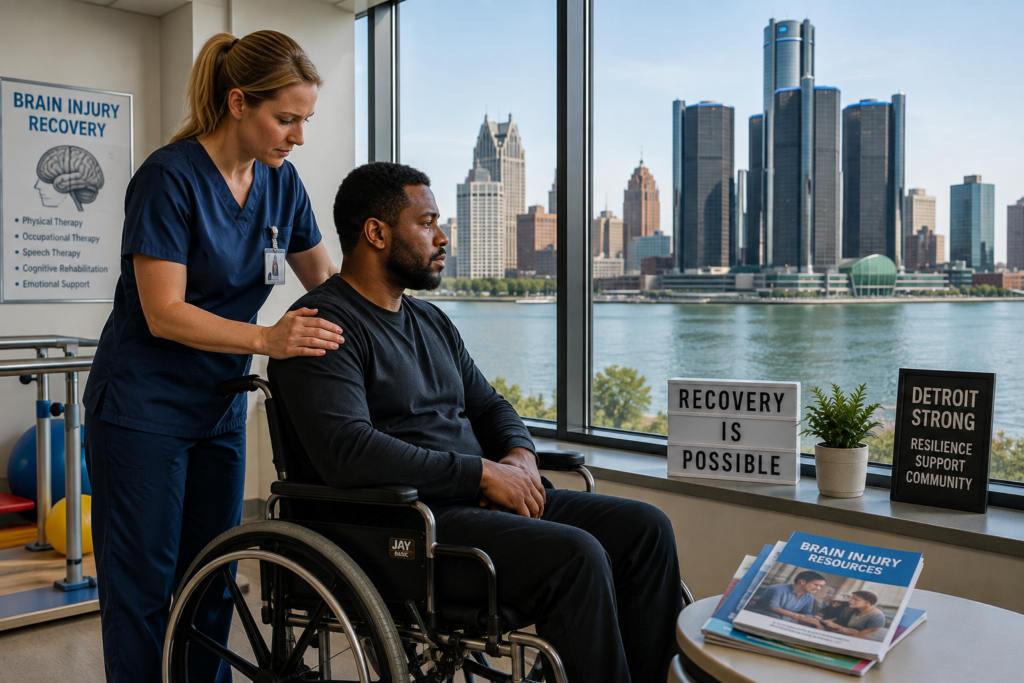
A traumatic brain injury patient undergoing rehabilitation in Detroit, reflecting the long-term treatment and recovery needs that can follow a serious accident.
Brain Injuries After Detroit Accidents
Detroit brain injuries can arise from many different types of accidents.
Potential causes include:
- Car crashes
- Commercial truck accidents
- Motorcycle collisions
- Pedestrian accidents
- Bicycle crashes
- Slip-and-fall accidents
- Dangerous property conditions
- Other significant trauma
Detroit’s transportation system includes major freeways, urban arterials, busy intersections, pedestrian corridors, and neighborhood streets. The city currently uses a designated High-Injury Network to focus safety efforts on corridors where serious crashes are concentrated.
Traumatic Brain Injuries From Detroit Car Accidents
Motor vehicle crashes are a major source of head trauma.
A person can suffer a brain injury when:
- The head strikes a window or dashboard
- The brain moves violently inside the skull
- The vehicle rolls over
- An occupant is thrown from the vehicle
- Airbags deploy during a severe impact
- Multiple impacts occur
A person does not necessarily have to strike their head directly to suffer a traumatic brain injury.
For automobile claims, visit our Detroit car accident lawyer page.
Brain Injuries From Truck Accidents
Commercial trucks can produce tremendous collision forces.
A truck crash may result in:
- Severe concussion
- Brain bleeding
- Skull fractures
- Diffuse axonal injury
- Loss of consciousness
- Permanent neurological impairment
Truck cases may also involve evidence such as driver logs, maintenance records, electronic vehicle data, and commercial insurance.
Visit our Detroit truck accident attorney page for truck-specific issues.
Motorcycle Brain Injuries in Detroit
Motorcyclists face an elevated risk of serious head trauma because they do not have a passenger compartment surrounding them.
A rider may suffer a brain injury from:
- Direct vehicle impact
- Contact with pavement
- Being thrown from the motorcycle
- Striking another object
- Secondary impacts
Helmet use can reduce risk, but it cannot prevent every brain injury.
For motorcycle cases, visit our Detroit motorcycle accident attorney page.
Pedestrian Brain Injuries
Pedestrians can suffer serious brain trauma when struck by a moving vehicle.
The injury may occur from:
- The initial impact
- Contact with the hood or windshield
- Being thrown onto pavement
- Secondary impacts
Detroit has specifically prioritized pedestrian and roadway safety as part of its broader Safe Streets for Detroit program, which is designed to reduce fatal and serious crashes on high-injury corridors.
For pedestrian cases, visit our Detroit pedestrian accident attorney page.
Bicycle Brain Injuries
Cyclists can suffer traumatic brain injuries when they are struck by cars or thrown from bicycles.
Possible circumstances include:
- Intersection crashes
- Dooring accidents
- Right-turn collisions
- Left-turn collisions
- Rear-end impacts
- Hit-and-run crashes
For bicycle-specific claims, visit our Detroit bicycle accident attorney page.
Brain Injuries From Falls
A fall can cause a serious brain injury when the head strikes:
- Concrete
- Tile
- Stairs
- A wall
- A railing
- Another hard surface
Falls may occur because of:
- Ice
- Wet floors
- Unsafe stairs
- Uneven walkways
- Broken flooring
- Other dangerous property conditions
For fall claims, visit our Detroit slip and fall attorney and Detroit premises liability attorney pages.
What Is a Traumatic Brain Injury?
A traumatic brain injury, or TBI, occurs when external force disrupts normal brain function.
Brain injuries can range from relatively mild concussions to catastrophic injuries resulting in permanent cognitive and physical disability.
Michigan’s Department of Health and Human Services maintains dedicated traumatic-brain-injury resources for people with TBI and their families, including information about recovery, rehabilitation, services, and support.
Mild Traumatic Brain Injury and Concussion
The word “mild” can be misleading.
A mild TBI or concussion may still cause substantial symptoms, including:
- Headaches
- Dizziness
- Memory problems
- Difficulty concentrating
- Fatigue
- Sleep disturbances
- Irritability
- Sensitivity to light
- Sensitivity to noise
- Balance problems
Some people recover relatively quickly. Others experience symptoms for months or longer.
Moderate and Severe Brain Injuries
More serious TBIs may cause:
- Extended unconsciousness
- Significant memory loss
- Cognitive impairment
- Speech difficulties
- Motor impairment
- Personality changes
- Seizures
- Permanent disability
- Need for ongoing assistance
Serious brain injuries may require extensive hospitalization and rehabilitation.
Diffuse Axonal Injury
A diffuse axonal injury can occur when rapid acceleration, deceleration, or rotational forces cause widespread damage to brain tissue.
These injuries may occur in:
- High-speed car crashes
- Truck collisions
- Motorcycle crashes
- Pedestrian impacts
Severe cases can produce profound neurological impairment.
Brain Bleeding and Hemorrhage
Traumatic injuries may produce bleeding inside or around the brain.
Examples can include:
- Subdural hematoma
- Epidural hematoma
- Intracerebral hemorrhage
- Subarachnoid hemorrhage
These can be medical emergencies requiring immediate evaluation and treatment.
Skull Fractures
A powerful impact can fracture the skull.
Skull fractures may accompany:
- Brain bleeding
- Brain swelling
- Neurological deficits
- Facial injuries
- Other serious trauma
The existence of a skull fracture can help demonstrate the severity of the force involved, although brain injuries can also occur without a fracture.
Can You Have a Brain Injury Without Losing Consciousness?
Yes.
Loss of consciousness is not required for a person to suffer a concussion or other traumatic brain injury.
Someone may remain awake after an accident while later developing:
- Headaches
- Confusion
- Memory problems
- Dizziness
- Difficulty concentrating
- Mood changes
That is one reason medical evaluation can be important after significant head trauma.
Delayed Brain Injury Symptoms
Some symptoms do not appear immediately.
A person may initially feel shaken but begin experiencing problems later that day or over subsequent days.
Possible delayed symptoms include:
- Persistent headaches
- Memory difficulties
- Confusion
- Sleep problems
- Mood changes
- Fatigue
- Difficulty working
- Reduced concentration
Symptoms that worsen or appear after an accident should be discussed with a qualified medical professional.
Cognitive Effects of a Brain Injury
Brain injuries can interfere with:
- Short-term memory
- Long-term memory
- Concentration
- Organization
- Problem solving
- Decision making
- Processing speed
- Executive functioning
These limitations can make even routine tasks significantly more difficult.
Emotional and Behavioral Changes
Some brain-injury survivors experience:
- Depression
- Anxiety
- Irritability
- Mood swings
- Impulsivity
- Social withdrawal
- Changes in personality
Family members may notice these changes before the injured person fully recognizes them.
Speech and Communication Problems
A brain injury can affect communication.
Potential difficulties include:
- Finding words
- Understanding language
- Organizing thoughts
- Speaking clearly
- Following conversations
Speech-language therapy may become part of rehabilitation.
Balance and Coordination Problems
Some brain injuries affect balance, coordination, and spatial awareness.
A person may experience:
- Dizziness
- Difficulty walking
- Falls
- Motion sensitivity
- Trouble driving
- Reduced coordination
These problems can interfere substantially with independence.
Brain Injury Rehabilitation in Detroit
Serious TBI recovery may involve several forms of rehabilitation.
Depending on the injury, a person may need:
- Physical therapy
- Occupational therapy
- Speech therapy
- Cognitive rehabilitation
- Neuropsychological treatment
- Vocational rehabilitation
- Behavioral therapy
Detroit is within Michigan’s Region 2 South trauma system, which includes Wayne County and the City of Detroit. Michigan’s trauma system is designed to coordinate hospitals, emergency services, and other care resources for people with serious injuries.
The Detroit Medical Center system also includes neuroscience and rehabilitation services, reflecting the type of specialized treatment that may become relevant after serious neurological trauma.
Rehabilitation Institute of Michigan
Some Detroit patients with serious trauma receive rehabilitation services through facilities such as the Rehabilitation Institute of Michigan.
Detroit city materials have documented treatment and recovery involving both DMC hospitals and the Rehabilitation Institute of Michigan following major trauma.
We would not claim that every client receives treatment at a particular facility. The point is that a serious Detroit brain-injury case may involve extensive local trauma and rehabilitation care.
Long-Term Care After a Brain Injury
A severe TBI may require care long after hospital discharge.
Future needs may include:
- Ongoing therapy
- Medication
- Neuropsychological care
- Assistance with daily activities
- Home modifications
- Transportation assistance
- Vocational services
- Supervision
- Long-term rehabilitation
Michigan provides dedicated brain-injury resources and post-acute rehabilitation services for qualifying individuals.
Returning to Work After a Brain Injury
Some people return to work quickly.
Others may struggle with:
- Concentration
- Memory
- Fatigue
- Communication
- Multitasking
- Emotional regulation
- Physical limitations
A person may need reduced hours, different duties, accommodations, or a change in occupation.
Loss of Earning Capacity
A brain injury can reduce a person’s ability to earn income even when they eventually return to work.
For example, someone may no longer be able to:
- Perform complex tasks
- Work long hours
- Manage staff
- Operate machinery
- Drive commercially
- Maintain previous productivity
Future earning losses should be supported by medical, employment, vocational, and economic evidence when appropriate.
How Do You Prove a Brain Injury?
Evidence can include:
- Emergency-room records
- Neurological evaluations
- MRI or CT imaging
- Neuropsychological testing
- Physician testimony
- Therapy records
- Family observations
- Employment records
- School records
- Evidence of changes in daily functioning
Not every brain injury produces a dramatic imaging abnormality.
Why Neuropsychological Testing Can Matter
Neuropsychological testing may evaluate:
- Memory
- Attention
- Processing speed
- Language
- Problem solving
- Executive functioning
- Emotional functioning
When appropriate, this testing can help document deficits that may not be obvious during an ordinary conversation.
Family Observations Can Be Important
Family members may notice changes such as:
- Forgetfulness
- Personality changes
- Irritability
- Difficulty following conversations
- Reduced motivation
- Problems managing finances
- Trouble completing familiar tasks
Those observations do not replace medical evidence, but they can help illustrate how the injury affects daily life.
Michigan No-Fault Benefits for Auto-Related Brain Injuries
When a brain injury results from a motor vehicle accident, Michigan no-fault insurance may become important.
Depending on the applicable policy and circumstances, PIP benefits may involve qualifying:
- Medical care
- Rehabilitation
- Wage loss
- Replacement services
Coverage should be evaluated based on the actual policies and circumstances rather than assuming every injured person has the same PIP benefits.
Can I Sue for a Brain Injury After a Detroit Car Accident?
Potentially.
Michigan allows certain claims against at-fault motorists for noneconomic damages when an injury satisfies the statutory automobile threshold.
A serious brain injury may potentially qualify as a serious impairment of body function, depending on the evidence and how the injury affects the person’s life.
For broader automobile liability issues, visit our Detroit car accident lawyer page.
What Compensation May Be Available?
Depending on the claim, damages may potentially include:
- Medical expenses
- Rehabilitation
- Future medical care
- Lost income
- Reduced earning capacity
- Pain and suffering
- Disability
- Loss of independence
- Other legally recoverable damages
The available categories depend on the underlying case.
What Is a Detroit Brain Injury Case Worth?
There is no standard brain-injury settlement.
Potential value may depend on:
- Severity of the TBI
- Length of unconsciousness
- Cognitive impairment
- Permanent symptoms
- Medical treatment
- Rehabilitation
- Ability to work
- Future earning capacity
- Need for assistance
- Liability evidence
- Insurance coverage
A concussion that resolves within weeks is very different from a severe TBI requiring lifelong care.
What If the Insurance Company Says My Tests Are Normal?
Brain-injury cases sometimes involve disputes because routine imaging does not show every form of neurological impairment.
The case may need to be evaluated using the full medical picture, including:
- Symptoms
- Clinical examinations
- Neuropsychological testing
- Treatment records
- Functional limitations
- Family observations
An insurer’s characterization of the injury is not necessarily the final medical conclusion.
What If I Had a Previous Concussion?
A prior concussion does not automatically prevent a new claim.
The important questions may include:
- What symptoms existed before the accident
- Whether the new accident caused additional injury
- Whether symptoms worsened
- Whether treatment changed
- What medical evidence shows
Pre-existing conditions require careful documentation rather than assumptions.
What Evidence Helps a Detroit Brain Injury Claim?
Potential evidence includes:
- Police or incident reports
- Crash photographs
- Surveillance footage
- Dashcam video
- Witness statements
- Medical records
- Imaging
- Neuropsychological testing
- Rehabilitation records
- Employment records
- Family testimony
- Expert opinions
Both the cause of the accident and the consequences of the brain injury must be documented.
What Should I Do After a Possible Brain Injury?
After significant head trauma:
- Seek medical attention.
- Follow medical recommendations.
- Report worsening symptoms.
- Keep treatment appointments.
- Preserve accident evidence.
- Keep copies of medical records and bills.
- Document missed work.
- Ask family members to note significant changes.
- Avoid signing settlement documents you do not understand.
- Consider legal advice if another party may have caused the injury.
How Long Do I Have to File a Brain Injury Lawsuit?
Michigan generally applies a three-year limitations period to many personal-injury actions, subject to exceptions.
However, an auto-related brain injury can also involve separate no-fault deadlines and insurance requirements.
Claims against governmental entities or arising from unusual circumstances may involve additional rules.
The safest approach is to investigate promptly rather than waiting until the limitations period is nearly over.
How Long Does a Brain Injury Case Take?
There is no standard timeline.
Brain injury cases may take longer because:
- Symptoms evolve
- Rehabilitation continues
- Future prognosis is uncertain
- Experts may be needed
- Work limitations need to be evaluated
- Liability may be disputed
- Litigation may become necessary
Resolving a serious TBI claim before the future consequences are understood can undervalue the injury.
Brain Injury vs. Spinal Cord Injury
Brain and spinal cord injuries are both neurological injuries, but they affect the body differently.
Brain injuries commonly affect cognition, memory, behavior, speech, and coordination.
Spinal cord injuries can affect movement, sensation, bowel and bladder function, and other physical systems below the level of injury.
For Detroit-specific information about paralysis, loss of mobility, rehabilitation, assistive equipment, long-term care, and other serious spinal injuries, visit our Detroit spinal cord injury attorney page.
Brain Injury vs. Personal Injury
A traumatic brain injury is a specific type of serious personal injury.
For other Detroit accident and negligence claims, visit our Detroit personal injury attorney page.
Frequently Asked Questions About Detroit Brain Injury Claims
Can I have a TBI without hitting my head?
Yes. Rapid acceleration and deceleration can cause the brain to move inside the skull even without direct head impact.
Can a concussion be serious?
Yes. Although classified as a mild traumatic brain injury, a concussion can cause symptoms that interfere substantially with work and daily life.
What if my CT scan was normal?
A normal CT does not automatically rule out every traumatic brain injury. Medical professionals evaluate symptoms, clinical findings, history, and other testing as appropriate.
Can symptoms appear later?
Yes. Some symptoms become apparent hours or days after the accident.
What if my personality changed after the accident?
Behavioral and emotional changes can occur after certain brain injuries. They should be discussed with qualified healthcare professionals and documented when relevant.
Can family members help prove the injury?
Family observations may help demonstrate changes in memory, behavior, independence, and functioning, although medical evidence remains important.
Can I recover future rehabilitation expenses?
Potentially, when future care is legally recoverable and supported by appropriate medical evidence.
How much does Khamo Law charge for a consultation?
Khamo Law offers free consultations for potential traumatic brain injury cases.
Why Choose Khamo Law for a Detroit Brain Injury Case?
A serious brain injury case is not simply about collecting an emergency-room bill.
The case may require documentation of:
- Cognitive impairment
- Long-term rehabilitation
- Reduced earning ability
- Loss of independence
- Future medical care
- Changes in family and daily life
Khamo Law represents people injured throughout Detroit and Metro Detroit and can investigate both the accident that caused the injury and the long-term consequences that follow.
The Detroit-specific focus is important because serious TBIs here frequently arise from the same transportation environments the city itself is targeting through its High-Injury Network and Safe Streets initiatives.
Speak With a Detroit Brain Injury Attorney
If you or a family member suffered a concussion, traumatic brain injury, brain bleed, or other serious neurological injury because of an accident in Detroit, Khamo Law can review what happened and explain your potential legal options.
Call 248-466-0606 or contact Khamo Law online for a free consultation.
Legally reviewed by Attorney Koro E. Khamo
Attorney at Khamo Law, PLLC