









Losing a family member because of another person’s negligence can leave a family dealing with grief, funeral expenses, lost financial support, unanswered questions, and a legal process they never expected to face.
Khamo Law represents families in wrongful-death cases arising from serious accidents in Detroit and throughout Metro Detroit.
A Detroit wrongful death attorney can investigate what caused the death, preserve evidence, identify responsible parties and available insurance, coordinate with the decedent’s estate, and pursue damages authorized by Michigan law.
If your family lost a loved one because of a fatal accident or other wrongful conduct in Detroit, call 248-466-0606 or contact Khamo Law online for a free consultation.
For broader injury representation involving motor-vehicle crashes, unsafe property, catastrophic injuries, and other negligence claims in the city, visit our Detroit personal injury attorney page.
What Is a Wrongful Death Claim in Michigan?
Michigan’s Wrongful Death Act provides a procedure for pursuing damages when a person dies because of a wrongful act, neglect, or fault that would have supported a legal claim had the person survived.
The wrongful-death action is brought through the deceased person’s estate by the personal representative, rather than each family member filing a separate lawsuit. Michigan courts describe the Wrongful Death Act as governing the damages and distribution process when an underlying legal claim results in death.
That distinction is important because the family members who may ultimately receive damages are not necessarily the people who formally file the lawsuit.
How Can a Detroit Wrongful Death Lawyer Help?
A wrongful-death investigation can involve both the underlying accident and the estate process that follows the death.
A Detroit wrongful death lawyer may help by:
- Investigating how the fatal incident occurred
- Identifying potentially responsible people and companies
- Preserving photographs and physical evidence
- Obtaining police and crash reports
- Seeking surveillance and dashcam footage
- Interviewing witnesses
- Reviewing applicable insurance policies
- Obtaining medical and employment records
- Documenting funeral and burial expenses
- Evaluating financial-support losses
- Working with the estate’s personal representative
- Coordinating with appropriate experts
- Negotiating with insurers
- Filing litigation when necessary
- Assisting with the wrongful-death settlement and distribution process
The investigation should be tailored to the type of accident rather than treating every fatal case the same way.
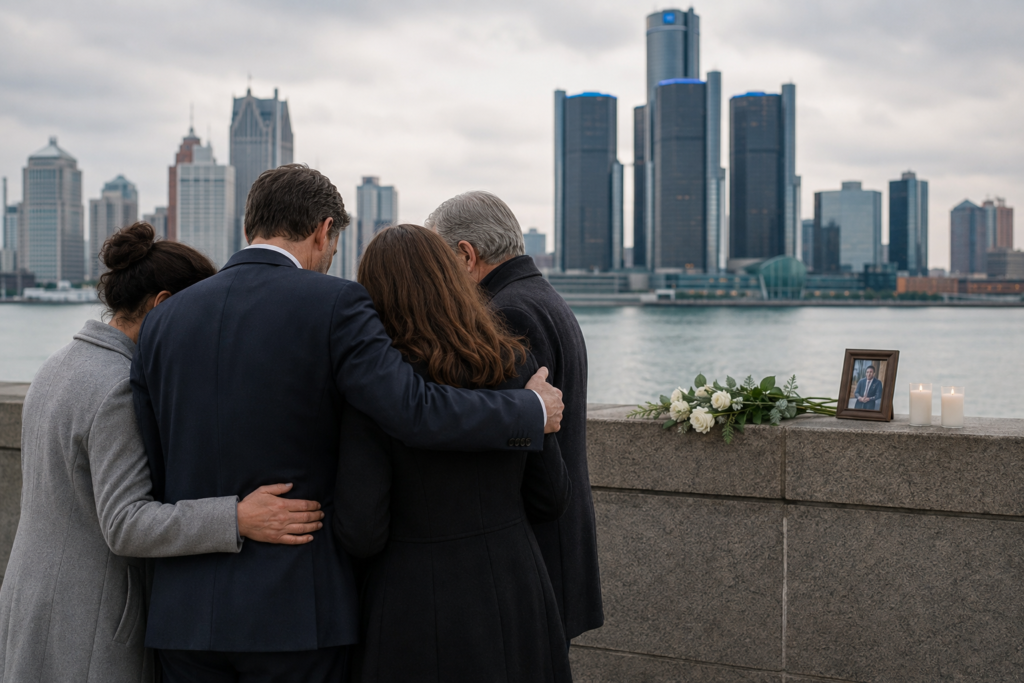
A grieving family gathers near the Detroit riverfront after the loss of a loved one, reflecting the personal impact of a fatal accident.
Wrongful Death Cases in Detroit
Detroit wrongful-death claims can arise from many types of serious accidents.
Examples may include:
- Fatal car accidents
- Commercial truck crashes
- Motorcycle collisions
- Pedestrian fatalities
- Bicycle crashes
- Dangerous property conditions
- Dog attacks
- Other negligent conduct
Each type of fatal accident can involve different liability, insurance, and evidence issues. This page focuses on the Michigan wrongful-death framework that applies when an otherwise actionable injury results in death.
Fatal Car Accidents in Detroit
A fatal car crash may involve:
- Distracted driving
- Speeding
- Drunk driving
- Failure to yield
- Unsafe lane changes
- Red-light violations
- Head-on collisions
- Multi-vehicle crashes
- Hit-and-run drivers
Evidence can include police reports, vehicle damage, electronic vehicle data, cellphone records, surveillance video, witness testimony, and accident reconstruction.
For automobile-specific information, visit our Detroit car accident lawyer page.
Fatal Truck Accidents in Detroit
Commercial truck fatalities can involve additional evidence and potentially responsible companies.
An investigation may need to examine:
- Driver logs
- Electronic logging devices
- Truck maintenance
- Inspection records
- Driver qualifications
- Cargo records
- Dispatch communications
- Trucking-company safety practices
- Commercial insurance
For more information, visit our Detroit truck accident attorney page.
Fatal Motorcycle Accidents
Motorcyclists have little physical protection when struck by a passenger vehicle or truck.
Fatal motorcycle collisions may involve disputes about:
- Left turns
- Right of way
- Speed
- Visibility
- Lane changes
- Driver distraction
- Insurance coverage
For motorcycle-specific legal and insurance issues, visit our Detroit motorcycle accident attorney page.
Pedestrian Deaths in Detroit
Pedestrian crashes can be particularly severe because a person on foot has no vehicle structure protecting them.
Fatal pedestrian accidents may happen at:
- Intersections
- Crosswalks
- Major corridors
- Neighborhood streets
- Parking lots
- Driveways
Detroit has made reduction of severe and fatal crashes an explicit transportation-safety goal through its Safe Streets for Detroit and Streets for People programs. The city identifies high-injury corridors and uses safety interventions aimed at reducing serious crashes and traffic deaths.
For pedestrian-specific information, visit our Detroit pedestrian accident attorney page
Fatal Bicycle Accidents
A bicyclist struck by a motor vehicle can suffer fatal trauma from either the initial impact or a secondary impact with the roadway or another object.
Evidence may include:
- Bicycle damage
- Vehicle damage
- Bike-lane configuration
- Intersection video
- Witness statements
- Dashcams
- Traffic-signal information
Visit our Detroit bicycle accident attorney page for bicycle-specific issues.
Fatal Accidents on Detroit Roads
Detroit’s transportation network includes high-speed freeways, major multi-lane corridors, downtown intersections, and neighborhood streets.
Potential fatal-crash locations include areas along:
- I-75
- I-94
- I-96
- M-10 / Lodge Freeway
- Woodward Avenue
- Gratiot Avenue
- Grand River Avenue
- Michigan Avenue
- Jefferson Avenue
- Eight Mile Road
The City of Detroit’s current safety planning specifically targets high-injury corridors and persistent crash patterns rather than treating all streets as having the same level of risk.
Dangerous Property Conditions and Fatal Injuries
Not every wrongful-death case involves a vehicle.
A fatal premises case may arise from circumstances involving:
- Dangerous stairs
- Serious falls
- Structural hazards
- Unsafe walkways
- Defective property conditions
- Other dangerous premises
These claims require separate analysis of who possessed or controlled the property and what duty was owed.
For dangerous-property cases, visit our Detroit premises liability attorney page.
Who Files a Michigan Wrongful Death Lawsuit?
The personal representative of the deceased person’s estate files the wrongful-death action.
This is different from saying that the surviving spouse, child, or parent simply files the case individually.
The personal representative acts on behalf of the estate and follows the procedures established by Michigan’s Wrongful Death Act.
Michigan courts also recognize the personal representative’s role in requesting court approval of wrongful-death settlements.
What Is a Personal Representative?
A personal representative is the person legally authorized to administer an estate.
Depending on the circumstances, the person may be:
- Named in an estate plan
- Appointed by the probate court
- A surviving spouse
- An adult child
- Another qualified person
Appointment as personal representative is separate from proving the underlying wrongful-death case.
The representative’s responsibilities can include pursuing the legal claim, providing required notices, addressing settlement issues, and assisting with distribution of proceeds according to Michigan law.
Does a Wrongful Death Case Require an Estate?
Typically, the wrongful-death claim proceeds through the decedent’s estate because Michigan law assigns the action to the personal representative.
That can mean a probate estate must be opened or an appropriate representative appointed if that has not already occurred.
Wrongful-death litigation and probate administration are related but distinct processes.
Who May Receive Wrongful Death Damages?
Michigan’s Wrongful Death Act identifies categories of people who may be entitled to damages in appropriate cases.
Depending on the family structure and circumstances, potential beneficiaries can include certain:
- Spouses
- Children
- Descendants
- Parents
- Grandparents
- Siblings
- Others recognized under the statute
Entitlement and distribution should be determined under the statute rather than assumed from ordinary inheritance expectations.
What Damages Can Be Recovered in a Michigan Wrongful Death Case?
Michigan’s Wrongful Death Act recognizes specific categories of damages.
Depending on the evidence, damages may include:
- Reasonable medical expenses associated with the final injury
- Hospital expenses
- Funeral expenses
- Burial expenses
- Pain and suffering experienced by the deceased before death when supported by the evidence
- Loss of financial support
- Loss of society and companionship
- Other damages authorized by Michigan law
The precise damages available depend on the underlying claim and circumstances.
Funeral and Burial Expenses
Funeral and burial costs can create an immediate financial burden.
Families should preserve:
- Funeral-home invoices
- Burial or cremation expenses
- Cemetery expenses
- Transportation costs when legally relevant
- Related receipts
These documents can help establish damages authorized under the wrongful-death framework.
Loss of Financial Support
A family may lose income or financial contributions that the deceased person would otherwise have provided.
An analysis may consider:
- Earnings history
- Employment
- Age
- Expected work life
- Financial contributions to the household
- Benefits
- Other relevant financial evidence
Serious claims may require economic analysis rather than simply multiplying the deceased person’s most recent annual income by a number of years.
Loss of Society and Companionship
Michigan wrongful-death law allows consideration of the loss of the relationship between the deceased person and qualifying family members.
Evidence may help show:
- The family relationship
- Frequency of contact
- Shared activities
- Caregiving roles
- Family traditions
- Emotional closeness
- The role the person played in the family
This is different from describing the survivors’ grief itself as a generic standalone “pain and suffering” claim.
The Decedent’s Pain and Suffering Before Death
When evidence shows that the deceased person survived for some period after the injury and experienced conscious pain or suffering, that may become part of the damages analysis.
Evidence may include:
- Emergency medical records
- Ambulance records
- Witness testimony
- Hospital records
- Physician testimony
- Other medical evidence
The availability and amount of this category depends heavily on what the evidence establishes.
What About the Survivors’ Emotional Distress?
This needs careful wording.
Michigan’s Wrongful Death Act permits damages such as loss of society and companionship, but we should not describe the survivors’ grief as though every family member automatically has a separate standalone pain-and-suffering claim.
The statutory categories should control the damages analysis. Michigan courts continue to treat damages under the Wrongful Death Act as governed by the statute rather than an unrestricted list of losses.
Can Lost Future Earnings Be Recovered?
This area deserves particular care.
Recent Michigan Supreme Court authority has addressed the scope of economic damages recoverable under the Wrongful Death Act, including limitations on lost-earning-capacity theories.
For that reason, I would not promise recovery of the deceased person’s entire projected lifetime earnings as a standard wrongful-death damage category.
Instead, the claim should be evaluated based on the specific categories Michigan law recognizes, including evidence concerning financial support actually lost by qualifying beneficiaries.
What If the Person Died Immediately?
A wrongful-death claim may still exist even when death occurred at the scene.
However, the available damages can differ from a case where the person survived for a period of time and experienced conscious pain and suffering or incurred extensive medical expenses.
The cause of action should be evaluated based on the actual evidence.
What If the Person Died Days or Weeks After the Accident?
A death does not have to occur immediately for the underlying injury to result in a wrongful-death case.
Medical evidence may be needed to establish the connection between:
- The original accident
- Resulting injuries
- Medical complications
- The eventual death
Insurance companies may dispute causation when significant time passes between the accident and death.
Proving Negligence in a Wrongful Death Case
Wrongful-death law does not automatically establish that someone was negligent.
The family still needs an underlying legal basis for liability.
Depending on the case, that may require proof of:
- A legal duty
- A breach of that duty
- Causation
- A resulting death and legally recoverable damages
The evidence required will depend on whether the case arose from a vehicle crash, dangerous property condition, dog attack, or another form of negligence.
What Evidence Can Help a Detroit Wrongful Death Case?
Potential evidence includes:
- Police reports
- Crash reports
- Photographs
- Surveillance video
- Dashcam recordings
- Witness statements
- Vehicle electronic data
- Cellphone records
- Medical records
- Autopsy or death-related records when relevant
- Employment records
- Insurance policies
- Business records
- Maintenance records
- Expert analysis
The relevant evidence depends on how the death occurred.
Why Preserving Detroit Surveillance Video Matters
Many fatal accidents in Detroit occur near:
- Businesses
- Apartment buildings
- Parking facilities
- Traffic corridors
- Downtown properties
- Residential doorbell cameras
Video can be overwritten within days or weeks.
A wrongful-death investigation should identify potential cameras early rather than assuming the footage will still exist months later.
Detroit Police and Crash Evidence
For fatal roadway collisions, law-enforcement evidence can be important.
Depending on the case, an investigation may involve:
- Police reports
- Crash diagrams
- Photographs
- Witness information
- Citations
- Toxicology evidence
- Reconstruction evidence
- Body-camera or other recordings when available
Police conclusions are important evidence, but they do not necessarily replace an independent civil investigation.
What If Criminal Charges Are Filed?
A fatal accident can sometimes lead to criminal charges, particularly when allegations involve impaired driving, reckless conduct, or other criminal behavior.
The criminal prosecution and civil wrongful-death claim are separate proceedings.
A criminal conviction may be relevant evidence, but a family does not necessarily have to wait for every criminal issue to conclude before protecting civil evidence and evaluating the wrongful-death claim.
What If No Criminal Charges Are Filed?
The absence of criminal charges does not automatically eliminate a civil wrongful-death claim.
Criminal and civil cases apply different legal standards and serve different purposes.
A driver or other defendant may still face civil liability even if prosecutors do not file criminal charges.
What If Multiple Parties Caused the Death?
Some fatal accidents involve more than one responsible party.
For example, a truck crash might involve allegations concerning:
- The truck driver
- Motor carrier
- Maintenance company
- Cargo loader
- Another driver
A dangerous-property death might involve:
- Property owner
- Tenant
- Property manager
- Maintenance contractor
The investigation should identify all potentially responsible parties rather than focusing automatically on the most obvious defendant.
What If the Deceased Person Was Partly at Fault?
Michigan comparative-fault law can affect damages when evidence shows that the deceased person contributed to the incident.
Fault may be disputed through evidence such as:
- Video
- Witness statements
- Crash reconstruction
- Physical evidence
- Electronic vehicle data
An insurer’s initial assignment of fault should not automatically be accepted without examining the evidence.
Insurance in a Fatal Detroit Accident
Insurance issues can significantly affect a wrongful-death claim.
Depending on the accident, potentially relevant coverage may include:
- Automobile liability coverage
- Commercial trucking insurance
- Uninsured or underinsured motorist coverage
- Property liability insurance
- Homeowner insurance
- Renter insurance
- Commercial general liability coverage
- Other applicable policies
The existence of a serious death does not automatically mean adequate insurance exists.
Michigan No-Fault Issues After a Fatal Motor Vehicle Accident
Fatal automobile accidents can involve Michigan no-fault benefits in addition to a liability claim.
Depending on the circumstances and available coverage, no-fault issues may include benefits associated with the injury and certain survivor-related benefits.
The insurance analysis should be conducted separately from the wrongful-death tort claim because the applicable deadlines and coverage rules may differ.
For auto-specific questions, visit our Detroit car accident lawyer page.
What If the At-Fault Driver Has Little or No Insurance?
A serious wrongful-death claim can exceed the responsible person’s liability coverage.
When appropriate, the investigation may consider:
- Uninsured motorist coverage
- Underinsured motorist coverage
- Commercial policies
- Umbrella policies
- Additional responsible parties
Coverage depends on the actual policies and circumstances.
How Long Do I Have to File a Michigan Wrongful Death Case?
Wrongful-death timing is more complicated than simply saying, “You have three years.”
The limitations period generally depends on the underlying legal claim that caused the death. Michigan courts explain that a wrongful-death action is governed by the limitations rules applicable to the underlying cause of action.
Michigan law can also provide a personal-representative saving provision in certain circumstances.
Because different underlying claims can have different deadlines, families should not rely on a universal wrongful-death deadline without reviewing the specific facts.
Why You Should Not Wait to Investigate
Even where a legal filing deadline is years away, evidence may disappear much sooner.
Examples include:
- Surveillance footage being overwritten
- Vehicles being repaired or destroyed
- Electronic data being lost
- Witness memories fading
- Property conditions being repaired
- Trucking records reaching retention limits
The practical investigation deadline can therefore be much earlier than the lawsuit deadline.
How Long Does a Detroit Wrongful Death Case Take?
There is no standard timeline.
Factors may include:
- Complexity of liability
- Number of defendants
- Insurance coverage
- Estate proceedings
- Investigation of damages
- Expert testimony
- Settlement negotiations
- Litigation
- Court scheduling
A case involving a straightforward vehicle collision may proceed very differently from a multi-defendant commercial trucking case.
How Are Wrongful Death Settlements Distributed?
Wrongful-death settlements involve procedures beyond simply sending the entire settlement to the personal representative.
Michigan law provides for court involvement in the settlement and distribution process.
The personal representative may request court approval of a wrongful-death settlement, and estate/probate procedures may be involved in determining distribution.
Families should understand that settlement approval and allocation are separate from proving liability against the defendant.
What If Family Members Disagree About the Settlement?
Disagreements can arise regarding:
- Whether to accept a settlement
- How damages should be allocated
- The value of different family relationships
- Estate administration
Michigan’s wrongful-death procedure provides a framework for notice, court review, and distribution rather than leaving these issues entirely to informal family agreement.
Wrongful Death of a Parent
The death of a parent can affect a family emotionally and financially.
Evidence may concern:
- Financial support
- Caregiving
- Household responsibilities
- Guidance
- Companionship
- Family relationships
The claim should reflect the legally recognized losses supported by the evidence.
Wrongful Death of a Spouse
The death of a spouse may involve evidence of:
- Financial contribution
- Shared household responsibilities
- Caregiving
- Companionship
- The nature of the marital relationship
Again, the analysis should stay within the damages Michigan law permits rather than using generic grief-based language.
Wrongful Death of a Child
A child’s death presents unique damages issues.
The analysis should not simply assume the value of the claim based on projected future wages.
Michigan wrongful-death law focuses on statutory damages and the evidence concerning the family relationship and other legally recognized losses. Recent Michigan authority concerning future earning capacity makes careful wording especially important.
Wrongful Death Attorney vs. Personal Injury Attorney
A wrongful-death case often begins with the same type of negligent conduct that would support a personal-injury claim if the person survived.
However, death changes:
- Who files the case
- How damages are evaluated
- Estate involvement
- Settlement procedures
- Distribution of proceeds
For nonfatal injury claims, visit our Detroit personal injury attorney page.
Frequently Asked Questions About Detroit Wrongful Death Cases
Can a family member personally file the lawsuit?
Michigan generally requires the wrongful-death action to be brought by the personal representative of the deceased person’s estate.
Do we have to open an estate?
A wrongful-death action ordinarily proceeds through an estate and personal representative, so probate administration may need to be addressed depending on the circumstances.
Can multiple family members recover?
Potentially. Michigan’s Wrongful Death Act identifies categories of qualifying beneficiaries, and entitlement depends on the family relationships and statute.
Can funeral expenses be recovered?
Potentially. Michigan wrongful-death damages can include reasonable funeral and burial expenses.
Can we recover for loss of companionship?
Potentially. Loss of society and companionship is an important statutory category when supported by the evidence.
Can survivors recover their own pain and suffering?
I would not describe it that way. Michigan law specifically recognizes statutory damages such as loss of society and companionship. The survivors’ grief should not automatically be presented as a separate standalone pain-and-suffering category.
What if the person lived for several days after the accident?
Medical records may support damages related to treatment and conscious pain and suffering before death, depending on the evidence.
What if no one was charged with a crime?
A civil wrongful-death claim may still exist. Civil negligence and criminal responsibility are separate questions.
How long do we have?
The deadline depends substantially on the underlying cause of action and may also involve estate-related saving provisions. It should be evaluated individually rather than relying on a single universal number.
How much does Khamo Law charge for a consultation?
Khamo Law offers free consultations for potential wrongful-death cases.
Why Choose Khamo Law for a Detroit Wrongful Death Case?
Wrongful-death litigation requires more than proving that a death occurred.
The case may require investigation of the underlying accident, identification of responsible defendants, insurance analysis, documentation of family and financial losses, coordination with the personal representative, and compliance with Michigan’s wrongful-death procedures.
Khamo Law represents families throughout Detroit and Metro Detroit in serious injury and fatal-accident matters.
Speak With a Detroit Wrongful Death Attorney
If your family lost a loved one because of a fatal car accident, truck crash, motorcycle collision, pedestrian accident, dangerous property condition, or other wrongful conduct in Detroit, Khamo Law can review what happened and explain the legal options that may be available.
Call 248-466-0606 or contact Khamo Law online for a free consultation.
Legally reviewed by Attorney Koro E. Khamo
Attorney at Khamo Law, PLLC