










Losing a family member because of another person’s wrongful conduct can leave a family dealing with grief, funeral expenses, lost financial support, unanswered questions, and a legal process they never expected to face.
A Sterling Heights wrongful death attorney at Khamo Law can investigate what caused the death, preserve evidence, identify potentially responsible parties, evaluate insurance coverage, coordinate with the deceased person’s estate, document family and financial losses, and pursue damages available under Michigan law.
A Sterling Heights wrongful death lawyer can also help families understand the estate process, available insurance coverage, potential damages, and the evidence that may be needed to support the underlying claim.
Khamo Law has an office in Sterling Heights at:
36250 Dequindre Road
Suite 110
Sterling Heights, MI 48310
Call 248-466-0606 for a free consultation.
For broader injury representation, visit Khamo Law’s Sterling Heights Personal Injury Lawyers page. For statewide information about wrongful death claims, liability, damages, and the rights of surviving family members under Michigan law, visit our Michigan Wrongful Death Lawyer resource.
How Can a Sterling Heights Wrongful Death Lawyer Help?
A wrongful-death case can involve both the underlying accident and the legal process involving the deceased person’s estate.
Khamo Law can help by:
- Investigating how the fatal incident occurred
- Identifying potentially responsible people and companies
- Preserving photographs, video, and physical evidence
- Obtaining police or incident reports
- Identifying witnesses
- Reviewing available insurance policies
- Coordinating with the personal representative of the estate
- Obtaining relevant medical records
- Documenting funeral and burial expenses
- Evaluating lost financial support
- Documenting the loss of society and companionship
- Communicating with insurance companies
- Evaluating settlement proposals
- Filing and litigating the underlying claim when appropriate
Michigan law requires a wrongful-death action to be brought in the name of the personal representative of the deceased person’s estate.
What Is a Wrongful Death Claim in Michigan?
Michigan’s Wrongful Death Act applies when a death results from a wrongful act, neglect, or fault that would have allowed the injured person to pursue a legal claim if death had not occurred.
The wrongful-death statute does not create liability simply because someone died.
The underlying case must still establish the legal basis for holding another person or company responsible.
Depending on the circumstances, that underlying claim may involve:
- Negligent driving
- Commercial trucking negligence
- Motorcycle collisions
- Pedestrian crashes
- Bicycle crashes
- Unsafe property conditions
- Other legally actionable conduct
For the broader statewide framework, visit our Michigan Wrongful Death Attorney page.
Who Actually Files a Michigan Wrongful Death Lawsuit?
This is one of the most important distinctions for families to understand.
Under Michigan law, the wrongful-death action is brought by and in the name of the personal representative of the deceased person’s estate.
That means individual family members do not ordinarily each file separate wrongful-death lawsuits.
The personal representative handles the claim through the estate while the statute determines which people may potentially be entitled to damages.
The Estate and Probate Process
Because the personal representative brings the wrongful-death action, the deceased person’s estate can become an important part of the process.
Sterling Heights is located in Macomb County, and the Macomb County Probate Court handles probate matters within the county and provides estate forms and information for opening a decedent’s estate.
The need to open or administer an estate depends on the circumstances.
Khamo Law can coordinate the wrongful-death claim with the appropriate estate process when necessary.
Who May Receive Wrongful Death Damages?
Michigan’s Wrongful Death Act identifies categories of people who may potentially be entitled to damages if they suffer losses because of the death.
Those categories can include certain:
- Spouses
- Children
- Descendants
- Parents
- Grandparents
- Brothers and sisters
- Other individuals identified by the statute under particular circumstances
Eligibility and the eventual distribution of proceeds depend on the statute, the estate, and the facts of the case.
Being a family member does not mean every person automatically receives the same amount.
What Damages Can Be Recovered?
Michigan’s Wrongful Death Act permits damages that a court or jury considers fair and equitable under the circumstances.
The statute specifically identifies categories including:
- Reasonable medical and hospital expenses for which the estate is liable
- Funeral and burial expenses
- Conscious pain and suffering experienced between injury and death
- Loss of financial support
- Loss of society and companionship
The available damages depend on the evidence and circumstances of the particular case.
Funeral and Burial Expenses
Funeral and burial expenses can create immediate financial pressure after a death.
Michigan’s wrongful-death statute expressly identifies reasonable funeral and burial expenses for which the estate is liable as a potentially recoverable category of damages.
Families should preserve:
- Funeral-home invoices
- Burial expenses
- Cemetery expenses
- Related receipts and records
Loss of Financial Support
A death may remove income or other financial contributions the family relied upon.
Evidence relating to financial support may include:
- Wage records
- Tax returns
- Employment records
- Benefits information
- Employment history
- Household financial records
- Evidence concerning expected future earnings
The analysis should reflect the deceased person’s actual circumstances rather than a generalized assumption about future income.
Loss of Society and Companionship
Michigan law expressly allows consideration of the loss of the deceased person’s society and companionship.
This can concern the nature of the relationship and the loss experienced by eligible surviving family members.
Evidence may include testimony and other information showing the role the deceased person played in the family.
Conscious Pain and Suffering Before Death
When an injured person survived for some period between the injury and death and experienced conscious pain and suffering, Michigan’s statute permits that harm to be considered as part of wrongful-death damages.
Whether this category applies depends on medical evidence and the particular circumstances.
Fatal Car Accidents in Sterling Heights
Motor-vehicle crashes are one potential source of wrongful-death claims.
Evidence may include:
- Sterling Heights Police crash reports
- Crash-scene photographs
- Vehicle damage
- Traffic-camera or surveillance footage
- Dashcam footage
- Witness statements
- Vehicle data
- Medical records
- Insurance policies
For collision-specific liability and insurance information, visit our Sterling Heights Car Accident Lawyer page.
Fatal Truck Accidents
Commercial truck crashes can involve additional sources of evidence and potentially responsible parties.
Potential evidence may include:
- Electronic logging information
- Commercial driver records
- Truck maintenance records
- Dispatch information
- Vehicle data
- Motor-carrier records
- Cargo information
- Commercial insurance policies
For truck-specific issues, visit our Sterling Heights Truck Accident Lawyer page.
Fatal Motorcycle Accidents
Motorcyclists have relatively little physical protection during a serious collision.
A fatal motorcycle case may require investigation of:
- Driver conduct
- Roadway configuration
- Vehicle movements
- Witness accounts
- Video
- Crash evidence
- Insurance coverage
Visit our Sterling Heights Motorcycle Accident Lawyer page for motorcycle-specific claims.
Fatal Pedestrian Accidents
Pedestrian fatalities can involve:
- Crosswalk collisions
- Intersection crashes
- Turning vehicles
- Low-light crashes
- Failure-to-yield disputes
- Hit-and-run incidents
- Commercial vehicles
Our Sterling Heights Pedestrian Accident Lawyer page addresses pedestrian-specific liability and evidence.
Fatal Bicycle Accidents
Fatal bicycle crashes can involve questions concerning:
- Passing distance
- Intersections
- Turning vehicles
- Visibility
- Roadway design
- Driver conduct
- Traffic controls
Visit our Sterling Heights Bicycle Accident Lawyer page for bicycle-specific claims.
Fatal Premises Liability Accidents
Unsafe property conditions can sometimes result in fatal injuries.
Potential cases may involve:
- Serious falls
- Unsafe stairs
- Dangerous walking surfaces
- Falling objects
- Other hazardous property conditions
For broader property claims, visit our Sterling Heights Premises Liability Attorney page.
Fatal Brain and Spinal Cord Injuries
Some traumatic brain injuries and spinal injuries ultimately result in death.
Khamo Law maintains dedicated resources for:
Those pages address the injury itself, while this page addresses the wrongful-death process when legally actionable injuries become fatal.
Evidence That May Matter After a Fatal Accident
Potential evidence can include:
- Police reports
- Crash reports
- Photographs
- Surveillance footage
- Dashcam video
- Witness statements
- Vehicle records
- Medical records
- Autopsy or medical-examiner records when relevant
- Employment records
- Tax documents
- Funeral and burial records
- Insurance policies
- Insurance communications
The appropriate evidence depends on what caused the death.
Sterling Heights Police and Accident Reports
Sterling Heights Police provides procedures for obtaining both police and traffic-crash reports.
The City states that accident reports can be searched using the State of Michigan, Sterling Heights Police Department as the jurisdiction, and the report number. Other police records may be requested through the Records Bureau or FOIA process.
The City’s Crime and Accident Reports resource can therefore be an important local starting point after a fatal incident investigated by Sterling Heights Police.
A report does not itself establish civil liability.
Why Early Evidence Preservation Matters
Some evidence can disappear quickly after a fatal accident.
For example:
- Surveillance footage may be overwritten
- Vehicles may be repaired or destroyed
- Road conditions may change
- Property hazards may be repaired
- Witness memories may fade
- Electronic records may be subject to retention policies
Early investigation can therefore matter even when a family is still determining who will serve as the estate’s personal representative.
Insurance Issues After a Fatal Accident
A wrongful-death case may involve several different insurance policies depending on how the death occurred.
Potential coverage may include:
- Automobile liability insurance
- Michigan No-Fault benefits
- Commercial motor-carrier insurance
- Homeowner insurance
- Commercial liability insurance
- Contractor coverage
- Other liability policies
Available coverage should be determined from the actual policies and facts.
Michigan No-Fault Issues After a Fatal Crash
When a death results from a motor-vehicle accident, Michigan No-Fault insurance can create additional issues beyond the wrongful-death liability claim.
Those insurance questions are statewide rather than unique to Sterling Heights, so the deeper No-Fault discussion should remain on Khamo Law’s Michigan automobile-insurance resources rather than being duplicated here.
Wrongful Death Settlements Require a Formal Process
Michigan law contains procedures governing settlement and distribution of wrongful-death proceeds.
The statute provides for court involvement in approving or rejecting certain proposed settlements and sets procedures for distributing settlement or judgment proceeds.
That is another reason a wrongful-death matter should not be treated like an ordinary insurance settlement.
How Wrongful Death Proceeds Are Distributed
Settlement or judgment proceeds are not necessarily divided equally among every surviving relative.
Michigan law establishes procedures for determining distribution based on the damages suffered by eligible people and the estate.
The personal representative must follow the required court procedures before proceeds are distributed.
How Long Do You Have to File a Wrongful Death Case?
This issue deserves careful treatment.
There is not one safe universal rule that every Michigan wrongful-death case must simply be filed within three years of the date of death.
The applicable limitation period depends on the underlying cause of action, and Michigan law also contains special provisions affecting actions brought by a deceased person’s personal representative. Michigan courts treat wrongful-death limitation questions through the underlying claim and applicable statutory rules.
Because different defendants or claims can also carry special notice requirements or shorter deadlines, the deadline should be evaluated from the specific facts rather than assumed from a generic statement.
What If a Government Vehicle or Public Entity Is Involved?
Cases involving governmental entities can involve special statutes, notice requirements, immunities, and deadlines.
That can affect incidents involving public vehicles, road conditions, public property, or governmental employees.
The exact requirements depend on the defendant and legal theory, so families should not rely on the ordinary personal-injury deadline when a governmental entity may be involved.
What Should a Family Do After a Fatal Accident?
There is no single checklist that fits every family.
When appropriate, useful steps may include:
- Preserve police or incident information.
- Save photographs and video.
- Preserve the deceased person’s important records.
- Identify available witnesses.
- Save insurance correspondence.
- Keep funeral and burial records.
- Preserve employment and income documentation.
- Determine whether an estate needs to be opened.
- Identify the personal representative.
- Avoid signing releases or settlement agreements that are not fully understood.
There is no need to delay necessary family, funeral, or probate matters simply to gather evidence.
Macomb County Probate Resources
Because Sterling Heights is in Macomb County, families who need information about a deceased person’s estate can use the Macomb County Probate Court.
The court maintains information concerning decedent estates, forms, filing procedures, and estate packets.
Probate administration and civil wrongful-death litigation are related but distinct processes.
Why Choose Khamo Law for a Sterling Heights Wrongful Death Case?
Wrongful-death claims may involve accident reconstruction, insurance coverage, estate administration, medical evidence, financial records, surviving-family losses, and court procedures for resolving and distributing the claim.
Khamo Law can investigate:
- What caused the death
- Who may be responsible
- What evidence should be preserved
- What insurance coverage exists
- Whether an estate representative needs to be involved
- What financial losses should be documented
- What family losses may be recoverable
- What procedural requirements apply
Khamo Law has an office in Sterling Heights at:
36250 Dequindre Road
Suite 110
Sterling Heights, MI 48310
By Appointment
Personal-injury matters are handled on a contingency-fee basis.
Call 248-466-0606 for a free consultation.
Sterling Heights Wrongful Death Attorney FAQs
Who files a Michigan wrongful death lawsuit?
Michigan law requires the action to be brought in the name of the personal representative of the deceased person’s estate.
Can family members receive compensation?
Potentially. Michigan law identifies categories of surviving individuals who may be entitled to damages when they suffer qualifying losses.
What damages can be recovered?
Potential damages can include qualifying medical expenses, funeral and burial expenses, conscious pain and suffering before death, loss of financial support, and loss of society and companionship.
Does every family member receive the same amount?
No. Michigan law provides a process for determining and distributing proceeds based on the losses involved rather than automatically dividing the recovery equally.
Do we need to open an estate?
A wrongful-death action must be brought by a personal representative, so estate administration may be necessary depending on the circumstances. Macomb County Probate Court provides local decedent-estate resources.
Can a fatal car accident lead to a wrongful death claim?
Potentially, when the underlying crash resulted from legally actionable conduct and the other requirements of Michigan law are met.
What if the accident involved a commercial truck?
The claim may involve additional evidence and commercial insurance issues. Our Sterling Heights truck-accident page addresses those collision-specific questions.
How long do we have to file?
The deadline depends on the underlying legal claim and other applicable statutes. Michigan wrongful-death deadline questions should be evaluated case by case rather than reduced to a universal three-years-from-death rule.
Is a wrongful death settlement automatically divided among the family?
No. Michigan law contains formal procedures governing settlement approval and distribution of wrongful-death proceeds.
How much does Khamo Law charge?
Khamo Law handles personal-injury matters on a contingency-fee basis. Attorney fees depend on obtaining a recovery rather than hourly billing throughout the case.
Speak With a Sterling Heights Wrongful Death Attorney
If your family lost a loved one because of another person’s or company’s wrongful conduct in Sterling Heights, Khamo Law can investigate what happened, preserve evidence, identify responsible parties and insurance coverage, coordinate with the estate process, and pursue damages available under Michigan law.
Call 248-466-0606 or contact Khamo Law online for a free consultation.
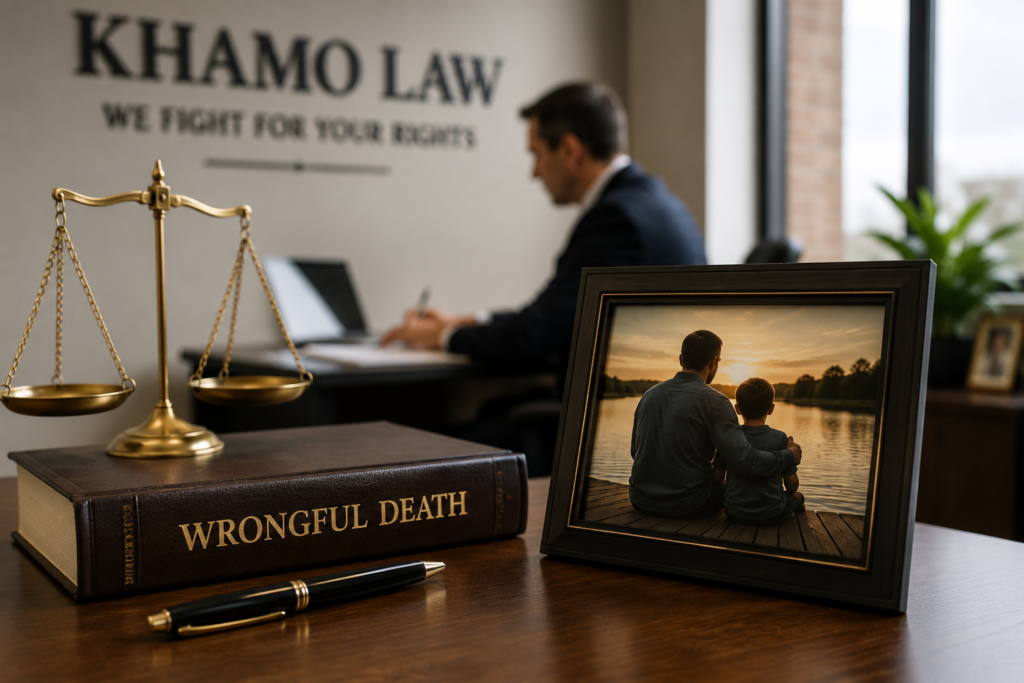
Wrongful death claims in Sterling Heights can help families pursue compensation after losing a loved one because of another party’s negligence.