



Valentine’s Day is often seen as one of the most romantic holidays of the year. Many couples plan special evenings, whether that means cooking at home, dining out, or attending a special event. In 2025, a survey by Statista found that 56% of Americans intended to celebrate the holiday. Many restaurants and bars lean into this trend by offering wine pairings and other Valentine’s-themed drinks, making alcohol a common part of these celebrations.
With road safety in mind, we wanted to examine whether crash risk on Valentine’s Day differs from a typical day of the year. Because alcohol is often present, Valentine’s Day presents an opportunity to examine whether this pattern is reflected in crash data.
As a result, the Troy car accident attorneys at Khamo Law partnered with data visualization firm 1Point21 Interactive to explore how alcohol-impaired crashes on Valentine’s Day compare with a typical day of the year. The analysis includes more than six million crashes across eight U.S. states, using the most recent three years of available data from 2022 to 2024.
Key Takeaways:
- Alcohol-related crashes increase by 10% on average on Valentine’s Day, and fatal crashes increase by 14%.
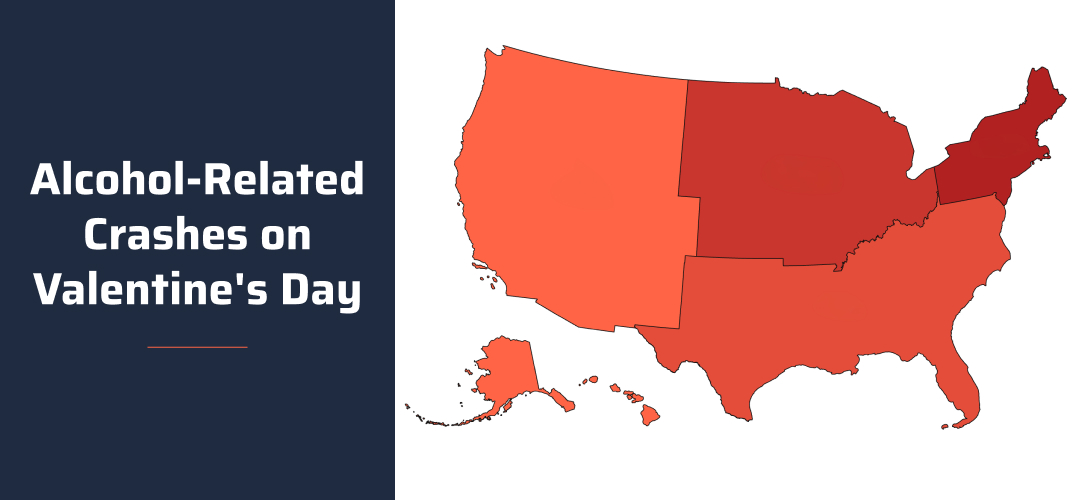
- By U.S. region, the largest increase occurs in the Northeast (27%) and the Midwest (18%), while the South shows a smaller rise (8%) and the West shows no increase.
- The most dangerous period to drive on Valentine’s Day is during the hours of 6 p.m. and 7 p.m., when alcohol-related crashes rise by 56% and 37%, respectively.
Crashes Rise on Valentine’s Day
On average, 6,320 crashes occurred on Valentine’s Day across the states in our sample — a 10% increase from the 5,759 crashes that occur on a typical day. As previously mentioned, alcohol related crashes also increased by 10%, suggesting that higher alcohol consumption on the holiday is linked to more dangerous road conditions.
Moreover, injury crashes rose by 5%, while fatal crashes increased by 14%, meaning fatal crashes grew at roughly three times the rate of injury crashes. This pattern suggests that Valentine’s Day is also associated with more severe crashes.
The Northeast Experiences the Highest Risk for Alcohol-Related Crashes
Valentine’s Day does not increase alcohol-related crash risk evenly across the country. The Northeast recorded the largest increase, with alcohol-related crashes rising nearly 27% above an average day, followed by the Midwest at 18%.
In contrast, the South saw a more moderate increase of 8%, while the West showed no rise at all, with a slight 1% decrease in alcohol-related crashes. Factors such as access to public transportation or rideshare services, winter weather conditions, enforcement strategies, and social habits all influence whether the holiday leads to more impaired driving on the road.
Valentine’s Day Alcohol-Related Crashes Spike in the Evening
For most of the early morning and midday hours, alcohol-related crashes on Valentine’s Day were lower than or similar to a typical day. From 1 a.m. through late morning, crash counts either declined or changed very little.
The pattern shifts in the late afternoon. Beginning around 3 p.m., alcohol-related crashes start to rise above normal levels, increasing by nearly 30% at 3 p.m. and 26% at 4 p.m. After a brief dip around 5 p.m., the risk spikes sharply in the evening.
The most dangerous window occurs between 6 p.m. and 7 p.m., when alcohol-related crashes rise 56% and 37% above a typical day. The dip at the hour of 8 p.m. may be due to a typical dinner time when fewer people are on the road. Risk continues to increase through the rest of the night, with alcohol-related continuing to show elevated totals from 9 p.m. through 11 p.m, when people may be leaving dinners, bars, or gatherings.
Enjoying a Safe Valentine’s Day
Our findings show that alcohol-related crashes rise sharply in the evening, with the hours after sunset shown to be the most dangerous time to be on the road. While couples and friends should feel free to celebrate however they choose, a little planning and mindfulness can help ensure the night ends safely.
- Plan your ride home before the date begins. Rideshare, public transit, or a designated driver are all options to consider. Such plans can be made before the night begins for ease of mind.
- Expect heavier impairment on the roads. Even if you are not drinking, you are more likely to encounter impaired drivers after dinner hours. Drive defensively, watch for sudden lane changes or speeding, and avoid distractions.
- Time your departure carefully. If you are out late, consider leaving earlier or staying longer to avoid the peak risk window in the evening when alcohol-related crashes surge.
- Be thoughtful if you’re hosting. If friends or couples are gathering at your home, offer food, nonalcoholic drinks, and a place to stay. Help arrange rides so no one feels pressured to drive.
Methodology
We analyzed a national sample of crash data (2022–2024) across eight states, covering all four U.S. regions, to examine patterns in alcohol-impaired crashes. These states include California, Colorado, Illinois, Iowa, Massachusetts, Mississippi, New York, and Texas. It is also worth noting that during the study period, Valentine’s Day fell on a Monday, Tuesday, and Wednesday, respectively.
Fair Use Statement
If you would like to help raise awareness about drinking and driving on Valentine’s Day, we encourage you to share this study. We kindly request that any report, mention, or replication of our findings include a link back to this page so readers can reference the full analysis.