






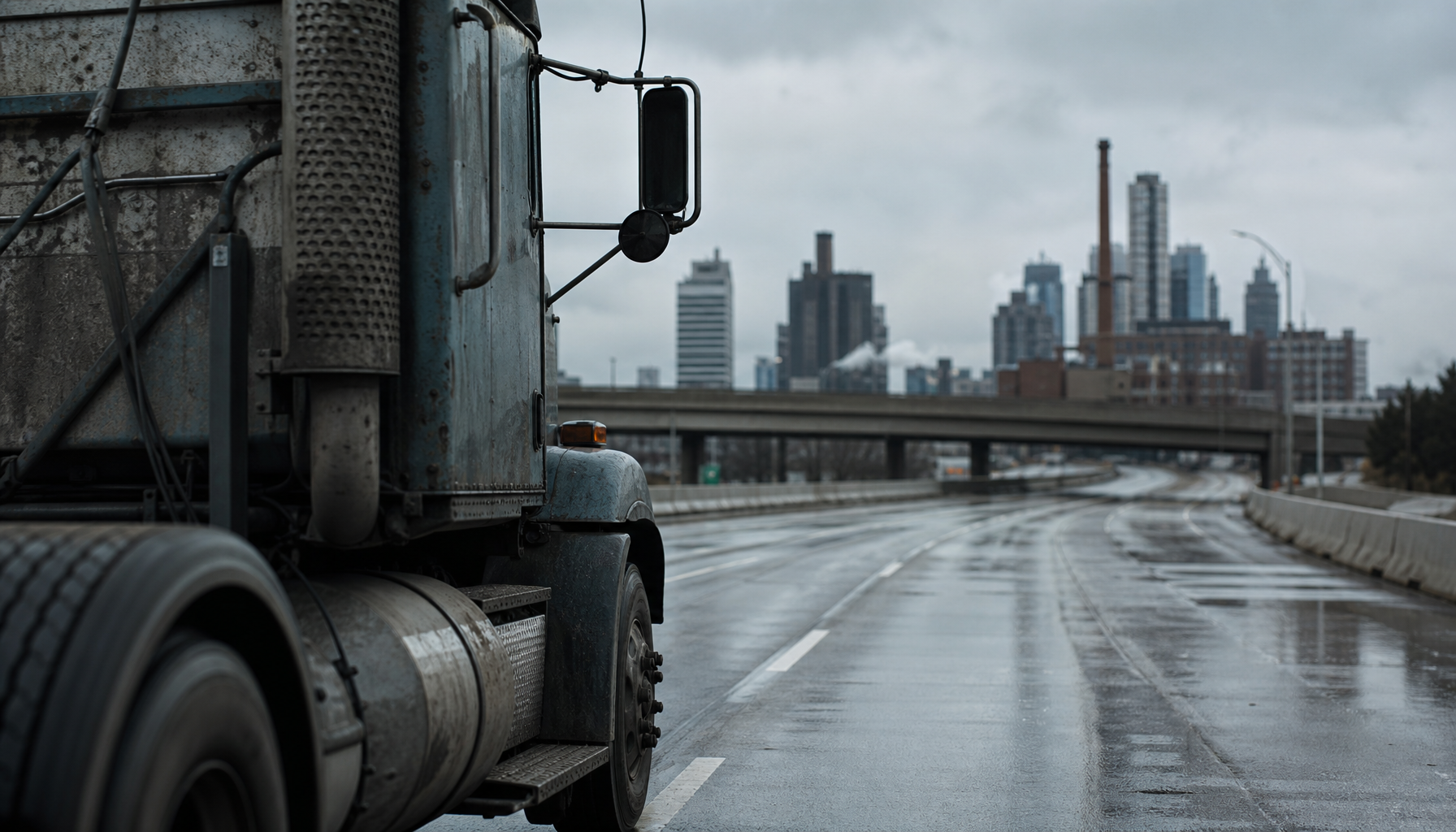
I-94 through Detroit moves more freight than almost any other urban corridor in the Midwest. Dozens of semi-trucks pass through the I-75/I-94 interchange alone every hour. When one of those trucks hits a passenger vehicle — and it happens here regularly — the damage is rarely minor. A loaded commercial truck can weigh 80,000 pounds. Your car weighs maybe 3,500.
If you’ve been hit by a semi-truck in Detroit or on one of the freight corridors feeding into the city, you’re dealing with something more legally complicated than a standard two-car crash. More insurance layers. Federal rules on top of state rules. A trucking company with its own lawyers already working the case. Here’s what Michigan law says you’re actually entitled to — and what you need to do to protect it.
If you were injured in a collision involving a semi-truck, tractor-trailer, delivery truck, or other commercial vehicle in Detroit, our Detroit truck accident attorney page explains how Khamo Law investigates commercial crashes, identifies potentially responsible trucking companies and other parties, preserves electronic and company records, and evaluates applicable insurance coverage. This article focuses specifically on the Michigan law and insurance issues that can arise after a Detroit semi-truck collision.
What Makes a Truck Accident Different Under Michigan Law
Michigan is a no-fault state. That means after most car accidents, you file with your own insurance first for medical bills and lost wages — regardless of who caused the crash. But semi-truck accidents open up additional claims that most car accidents don’t.
Trucking companies carry commercial liability policies that are often $1 million or more. Federal Motor Carrier Safety Administration (FMCSA) regulations require it. That coverage exists specifically because the harm these vehicles cause is categorically different from a fender-bender. If the truck driver or the company was at fault, you have a direct claim against that commercial policy — separate from your own no-fault coverage.
You may also have claims against multiple parties at once: the driver, the trucking company, a freight broker, the company that loaded the cargo, or a maintenance contractor who failed to catch a brake problem. Knowing how commercial truck liability works in Michigan before you talk to any insurance adjuster is worth your time.
What Benefits Michigan’s No-Fault Law Covers
Under MCL 500.3107, your Personal Injury Protection (PIP) coverage pays for:
- All reasonably necessary medical expenses — with no dollar cap if you have unlimited PIP
- 85% of your lost wages, up to a set monthly maximum, for up to three years
- Replacement services — someone to handle household tasks you can’t do while injured
- Attendant care if your injuries require in-home nursing or personal assistance
These benefits come from your own insurer first. Don’t wait for the trucking company to offer you anything before you file with your own carrier. That first PIP claim is your floor — not your ceiling.
When You Can Sue for Pain and Suffering
Michigan’s no-fault threshold under MCL 500.3135 allows you to sue for non-economic damages — pain, suffering, disability, and loss of enjoyment of life — when your injury meets one of these standards:
- Death
- Permanent serious disfigurement
- Serious impairment of a body function
“Serious impairment” doesn’t mean you need to be paralyzed. A herniated disc that limits your ability to work, sleep, or care for your family has qualified. Torn ligaments, traumatic brain injuries, and fractured vertebrae regularly clear this threshold in cases involving semi-trucks, because the forces involved are simply larger. If you’re unsure whether your injury qualifies, read what we’ve explained about how Michigan calculates pain and suffering after a crash.
Federal Rules That Work in Your Favor
Here’s something many people don’t know: commercial trucking is regulated by federal law, and those regulations create a paper trail that can prove negligence.
Hours-of-service logs — Under 49 CFR Part 395, truck drivers are limited in how many consecutive hours they can drive. A driver who was over-hours when they hit you has violated federal law. That violation is evidence of negligence.
Inspection and maintenance records — Under 49 CFR Part 396, trucking companies must keep records of every pre-trip inspection, every repair, every brake check. If a mechanical failure caused the crash and the records show it was ignored, that’s not just negligence — it may support a claim for additional damages.
These records don’t stay available forever. Trucking companies are required to keep them for a limited period, and once litigation isn’t anticipated, they may be purged. An attorney can send a spoliation letter — a legal demand to preserve evidence — within days of the crash. Waiting weeks to do this is a real risk. You can learn more about what commonly causes truck accidents on Michigan roads and how those factors connect to federal violations.
The Three-Year Clock — and Why It Starts Now
Michigan’s statute of limitations for personal injury claims is three years from the date of the accident (MCL 600.5805(2)). Three years sounds like a long time. It isn’t, once you account for gathering records, identifying all liable parties, and building a damages picture that holds up.
There are also shorter deadlines baked into no-fault claims — particularly for uninsured motorist coverage and certain notice requirements. Missing those can cost you benefits even if your lawsuit is still timely. A deeper breakdown of Michigan’s auto accident claim deadlines explains how these interact.
What to Do in the Days After the Crash
- Get medical attention the same day, even if you feel okay. Adrenaline masks injury. A gap in treatment gives insurers a reason to dispute your claim.
- Don’t give a recorded statement to the trucking company’s insurer. They are not on your side.
- Photograph everything — your vehicle, the truck, the road, the cargo, any skid marks.
- Get the truck’s DOT number and the carrier name off the door. These identify the company and its insurance.
- Ask the police for the report number and get a copy as soon as it’s available.
- Write down everything you remember about the moments before impact while your memory is sharp.
- Contact an attorney before you sign anything.
For a more detailed walkthrough of the full process, we’ve put together a step-by-step guide to what to do after a truck accident in Michigan.
The Lodge, I-75, I-94 — Detroit’s Freight Routes Are High-Risk
The stretch of I-94 from the interchange at I-75 eastward through the city sees heavy commercial truck traffic around the clock. The Lodge Freeway (M-10) feeds into downtown and connects to I-94 — a corridor where a rollover crash near the Lodge and I-94 showed just how quickly freight-corridor accidents close major roads and create injury claims. These aren’t abstract statistics. People who live in Detroit, drive to work in Detroit, and cross these highways every day are the ones getting hurt.
Frequently Asked Questions
Can I sue the trucking company directly, or only the driver?
You can often sue both. Under a legal theory called respondeat superior, trucking companies are liable for their drivers’ negligence when the driver was acting within the scope of employment. You may also have independent claims against the company for negligent hiring, negligent supervision, or failing to maintain the vehicle — claims that don’t depend on what the driver did.
What if the truck driver was an independent contractor?
Trucking companies sometimes try to classify drivers as contractors to avoid liability. Courts and the FMCSA look past labels. If the company controlled how the driver operated — routes, schedules, equipment standards — the contractor designation may not protect them. An attorney can analyze whether the company retained enough control to be held liable.
My PIP insurance is paying my bills. Do I still need to pursue the trucking company?
Yes. PIP covers medical bills and partial lost wages — but it doesn’t compensate you for pain, permanent limitation, or the full scope of what you’ve lost. If your injuries meet Michigan’s threshold under MCL 500.3135, you have a separate claim for non-economic damages against the at-fault party. Those two claims run on parallel tracks.
The trucking company’s insurer called me the day after the crash. Should I talk to them?
No. That call is not a courtesy. The adjuster is gathering information to minimize what the company pays you. You have no obligation to give a recorded statement to the other party’s insurer. Speak with an attorney first.
How long does a truck accident case take in Michigan?
It varies. Some cases settle within a year. Cases involving disputed liability, severe injuries, or multiple defendants can take two to three years. The strength of the evidence — particularly the federal maintenance and hours-of-service records — often determines how quickly a trucking company decides to settle. You can read more about how long Michigan accident cases typically take and what factors affect the timeline.
What if my injuries don’t seem that bad right now?
Some truck-accident injuries — particularly soft-tissue damage and traumatic brain injuries — don’t fully present for days or even weeks. See a doctor now, document everything, and don’t close any claims or sign any releases before you know the full picture. Once you sign a release, it’s done.
If you were injured in a commercial truck crash in Detroit, learn more about how Khamo Law handles these cases on our Detroit truck accident attorney page. You can also call Khamo Law at 248-466-0606 or contact us online for a free consultation.